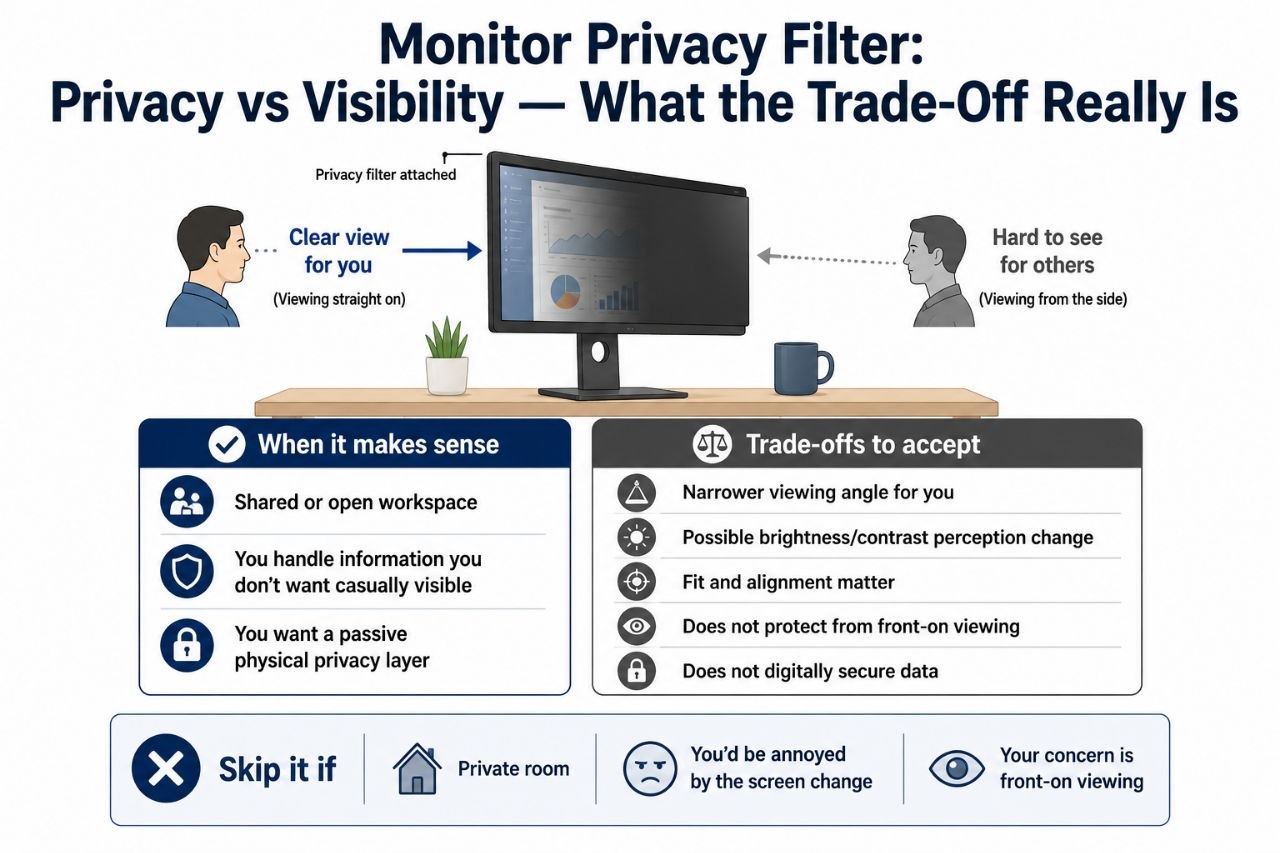
What a monitor privacy filter is supposed to do
A monitor privacy filter is a panel that attaches to your screen and narrows the viewing angle. From directly in front, the screen looks normal enough. From the side, the content becomes much harder to see.
The intended use is simple: stop people sitting or standing to the side from casually reading your screen.
When it makes sense
A privacy filter is a reasonable buy if:
- You work in a shared or open space where people pass by or sit nearby.
- You handle information you would rather not have casually visible.
- You want a physical, passive layer of privacy rather than relying only on screen positioning or behavior.
In those situations, the privacy benefit is real and direct.
What people often underestimate: the visibility cost to you
A privacy filter does not just affect other people. It also changes the screen for the person using it.
Common trade-offs include:
- Narrower effective viewing angle for you. If you sit slightly off-center, lean back, or tilt the screen, the screen can look dimmer or less clear than without the filter.
- Some reduction in brightness or contrast perception. The amount varies by filter, but the effect is real enough that some users notice it.
- Potential fit and alignment irritation. If the filter is not sized or installed well, it can be annoying in daily use.
So a privacy filter is not “privacy with no downside.” It is “privacy with a visibility trade-off that you need to be okay with.”
What a privacy filter does not do
- It does not secure your data digitally. It is a physical, visual layer, not a security system.
- It does not make the screen private from someone directly in front of it. It is about side viewing, not front viewing.
- It does not replace thoughtful workspace setup. If someone can sit directly in front of your monitor, a privacy filter does less for you.
When you can skip it
- Your space is private enough already. If you work alone in a private room, the privacy benefit may be negligible.
- You would be annoyed by the change in your own screen experience. If you are sensitive to any reduction in brightness, contrast, or viewing angle, a filter may not be worth it.
- Your privacy concern is mainly about front-on viewing. A filter helps less with that.
Practical things to check before buying
- Size match. Privacy filters are sized to specific screen dimensions, so a good fit matters.
- Installation method. Some attach with magnets, some with adhesive, some with clips. Pick one that suits your monitor and whether you want a reversible install.
- How you actually sit. If you sit straight on, the visibility trade-off may be minor. If you sit off-angle a lot, test the idea carefully.
A home office context
In a home office, the privacy question is different from an open office. The main audience is usually household members, visitors, or camera coverage rather than coworkers passing by. That does not mean a privacy filter is never useful at home — it can still matter — but the reason to buy it is more specific.
Bottom line
A monitor privacy filter is a genuine tool for limiting side viewing of your screen, and it can make sense in shared or semi-shared spaces. The trade-off is that it also changes the screen experience for you, so the right question is not “does it give privacy?” but “is the privacy worth the visibility cost to my own use?”
Shop the Hemi Life pick
14-Inch Monitor Privacy Screen Filter, Anti-Peeping Display… — Check on Hemi Life.