The situation
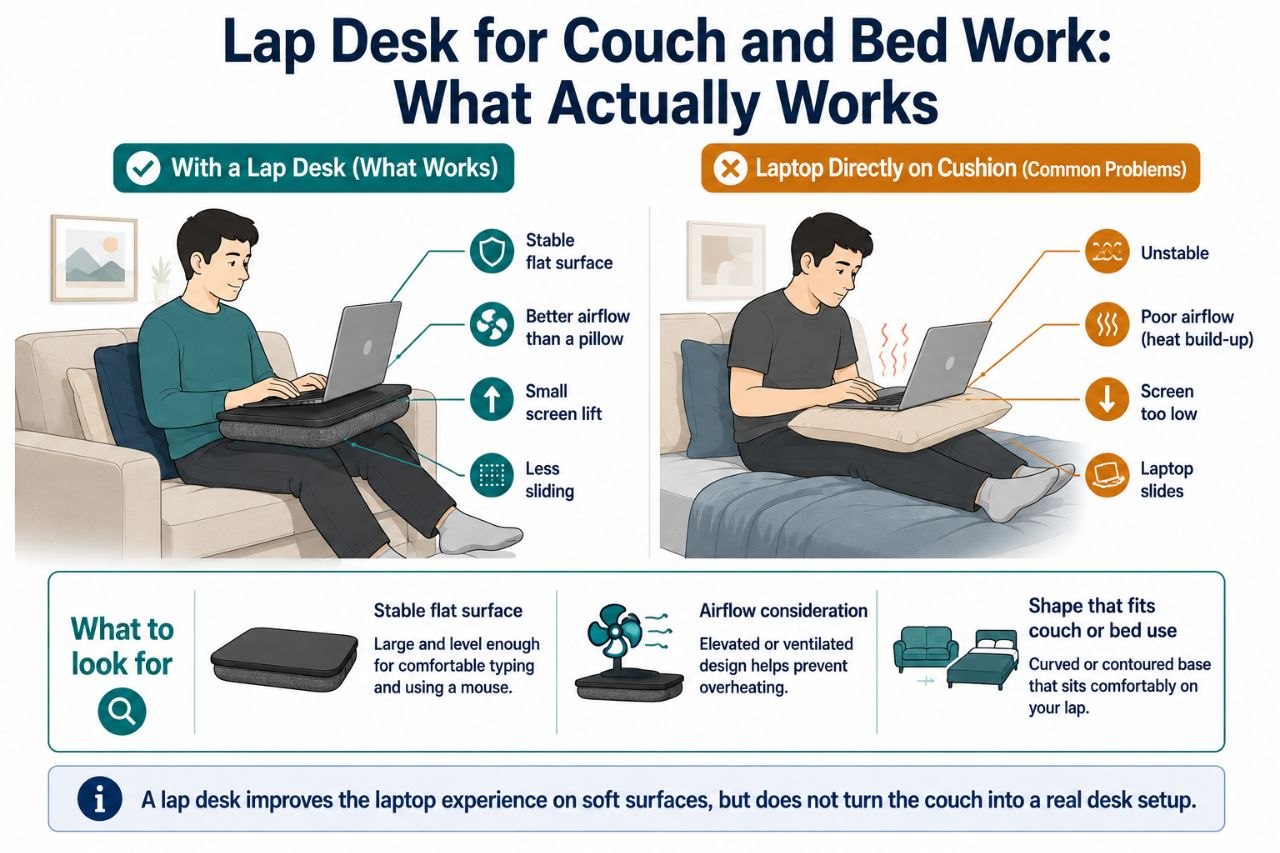
Couch and bed work is common, and it comes with a set of predictable annoyances: the laptop slips, the surface is soft or uneven, airflow can be limited, and the screen ends up low, which pulls your neck and shoulders into a tiring position.
A lap desk is one response to that situation. It is not a full fix, and it is not always the best one. The useful question is what it actually improves and where it falls short.
What a lap desk can improve
- A stable, flat working surface. That is the basic benefit. A laptop on a lap desk is usually more stable than a laptop balanced on a cushion, blanket, or lap alone.
- Better airflow than a soft surface. Many lap desks have a design that lets air reach the laptop bottom better than a pillow or mattress does. That matters for heat and for the laptop itself.
- A small lift for the screen. Even a modest lift can improve the viewing angle a bit compared with the laptop sitting low in your lap.
- Less sliding. On a couch or bed, a laptop can shift around. A lap desk can reduce that.
So for light couch-and-bed work — reading, writing, video calls, browsing, light tasks — a lap desk can genuinely improve the experience.
Where a lap desk does not fix things
- It does not make couch work ergonomic like a real desk. The posture is still not the same. A lap desk improves the laptop use, not the whole body setup.
- It does not fully solve screen height. If the screen is still low relative to your eyes, your neck may still be the weak point.
- It does not make long sessions comfortable by itself. A lap desk can make a laptop easier to use on the couch, but it does not turn the couch into a proper workstation.
- It does not guarantee good airflow in every case. Some lap desks are better than others; a bad one can still trap heat.
What to look for
A lap desk that earns its place usually has:
- A stable, flat surface that does not wobble much.
- Some airflow consideration — a design that does not seal the laptop bottom against you.
- A shape that fits where you actually use it. A couch lap desk and a bed lap desk are not always the same thing.
- A size that fits your laptop without being awkwardly large or small.
If you switch between couch and bed a lot, it is worth thinking about which situation matters more, because the ideal shape and feel can differ.
Free or cheap alternatives worth considering
- A firm cushion or board under the laptop can improve stability and airflow in a pinch.
- A small lift for the laptop — even a simple object — can improve screen angle.
- Position changes and breaks matter more on a soft surface than at a real desk.
These are not as clean as a lap desk, but they cover part of the same problem for less money.
When a lap desk is worth it
- You do real work from the couch or bed, even if only sometimes.
- You want a more stable and more comfortable laptop surface than what you have now.
- You value the convenience enough to justify one more object.
When you can skip it
- Your couch/bed laptop use is very occasional.
- You already have a workable setup for those moments.
- You expect it to make couch work as good as a desk setup — it will not.
Bottom line
A lap desk is best thought of as a practical comfort and stability upgrade for couch and bed laptop use. It improves the laptop experience, but it does not turn a soft surface into a real desk. If your use is light-to-moderate and you want a better place to set the laptop, it can be a sensible buy. If your use is very occasional or you expect more than it can deliver, it is easy to skip.