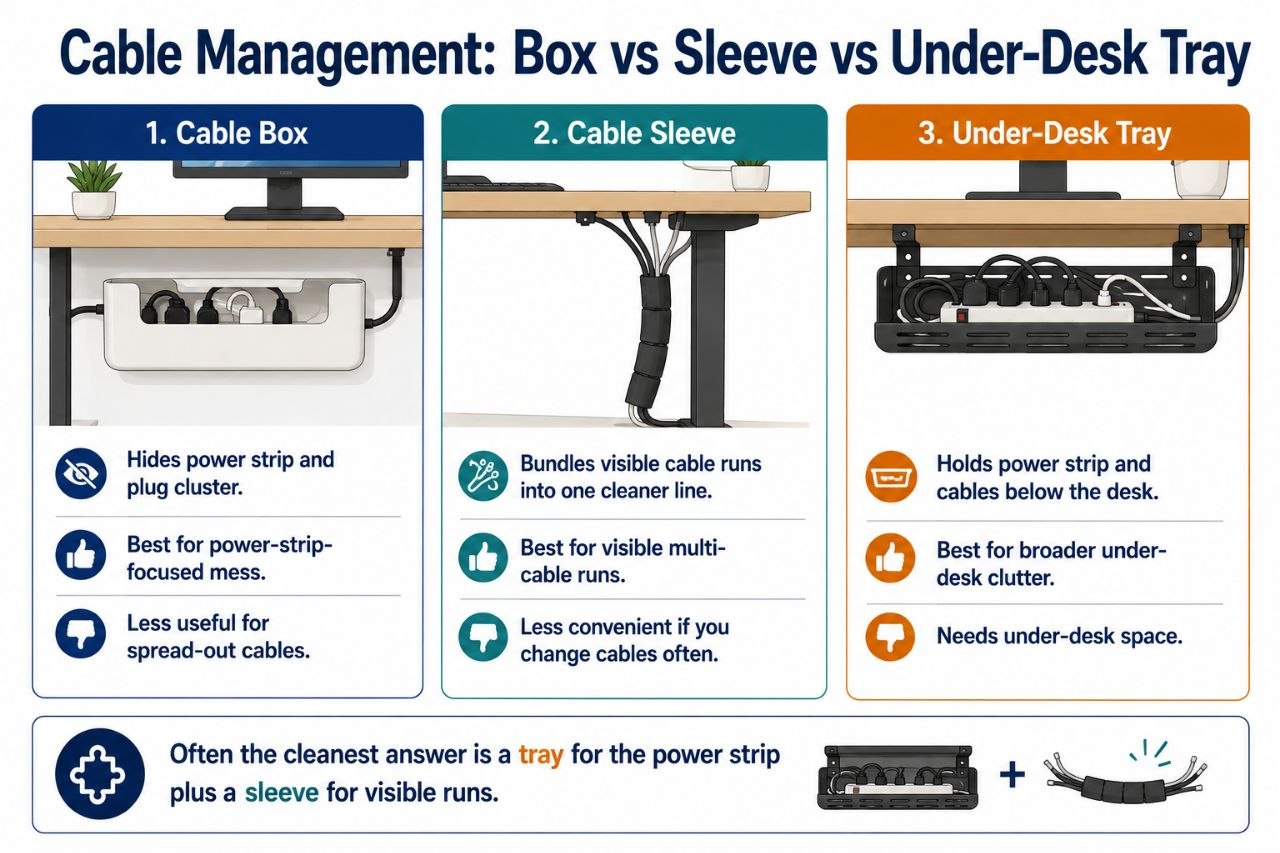
The first split: what part of the mess are you solving?
Cable management is not one product. It is a set of approaches that solve different parts of the same general problem. The useful question is which part of your cable mess you are actually trying to fix.
The three common options are:
- Cable boxes — a box that hides a power strip and the tangle of plugs and cables around it.
- Cable sleeves — a wrap that bundles several cables together into one cleaner-looking line.
- Under-desk trays — a tray mounted below the desk surface to hold cables, a power strip, or both.
Each one has a different job, and the right choice depends on what kind of mess you have.
Cable box
What it is good for: hiding a power strip and the loose plug tangle around it. If your main eyesore is the power strip and its cluster of cables on the floor or under the desk, a box can contain that in one cleaner object.
Good fit when:
- You have a power strip visibly cluttering the area.
- You want the power strip out of sight but still accessible.
- The main problem is the power strip, not a long visible cable run.
Less ideal when:
- You have many cables spread around that are not all at the power strip.
- You want to bundle or route cables, not just hide one cluster.
- The box is too small for your power strip and plug count.
Cable sleeve
What it is good for: bundling several cables that run together into one cleaner-looking line. If you have a visible bundle of cables going from the desk to a wall outlet or along a leg, a sleeve can make that look less messy.
Good fit when:
- You have a visible cable run that looks messy because several cables are loose together.
- You want a cleaner line rather than hiding everything.
- The cables are relatively static and do not need frequent changes.
Less ideal when:
- You need to access cables frequently — sleeves make that less convenient.
- The main issue is a power strip or under-desk tangle rather than a visible run.
- You have only one or two cables, where a sleeve is more than you need.
Under-desk tray
What it is good for: holding cables, a power strip, or both below the desk surface. This is the more comprehensive option — it gets more of the cable clutter off the floor or out from under the desk and into a dedicated space.
Good fit when:
- You have a power strip and several cables under the desk.
- You want the cable clutter hidden below the desk rather than visible or on the floor.
- You have enough under-desk space for a tray.
Less ideal when:
- Your desk does not have much under-desk space.
- You only have one or two cables and a tray is overkill.
- Installation is a problem for your desk or your setup.
How to choose
A practical way to think about it:
- Main problem is the power strip and its cables visible on the floor or under the desk → cable box.
- Main problem is a visible bundle of cables running along a leg or edge → cable sleeve.
- Main problem is broader under-desk cable clutter and a power strip → under-desk tray.
You can also combine them. A tray can hold the power strip, and a sleeve can bundle the visible run. That is often the cleanest real-world answer.
A Hemi Life connection
Hemi Life offers a silicone desk cable holder, which is a simpler, smaller-scale cable management tool. It is useful for keeping individual cables or small bundles in place on the desk surface. If your problem is more about under-desk clutter than surface cable control, a box, sleeve, or tray may be the better match; if you mainly want to keep a cable or two tidy on the desk, the silicone holder is a more targeted option.
Bottom line
Cable management works best when you match the tool to the mess. A box hides a power strip cluster, a sleeve cleans up a visible cable run, and a tray handles broader under-desk clutter. If you have more than one kind of cable problem, a combination is often the most effective answer.
Shop the Hemi Life pick
Desk Cable Management Kit — Check on Hemi Life.