What the material difference actually means
A mouse pad with a wrist rest is a small thing, but the material changes how it feels and what it is good for. The three common options — gel, memory foam, and wood — are not just aesthetic choices. They feel different under the wrist and suit different preferences.
The right one depends less on marketing and more on how you want the wrist rest to feel and how you use the mouse.
Gel wrist rest
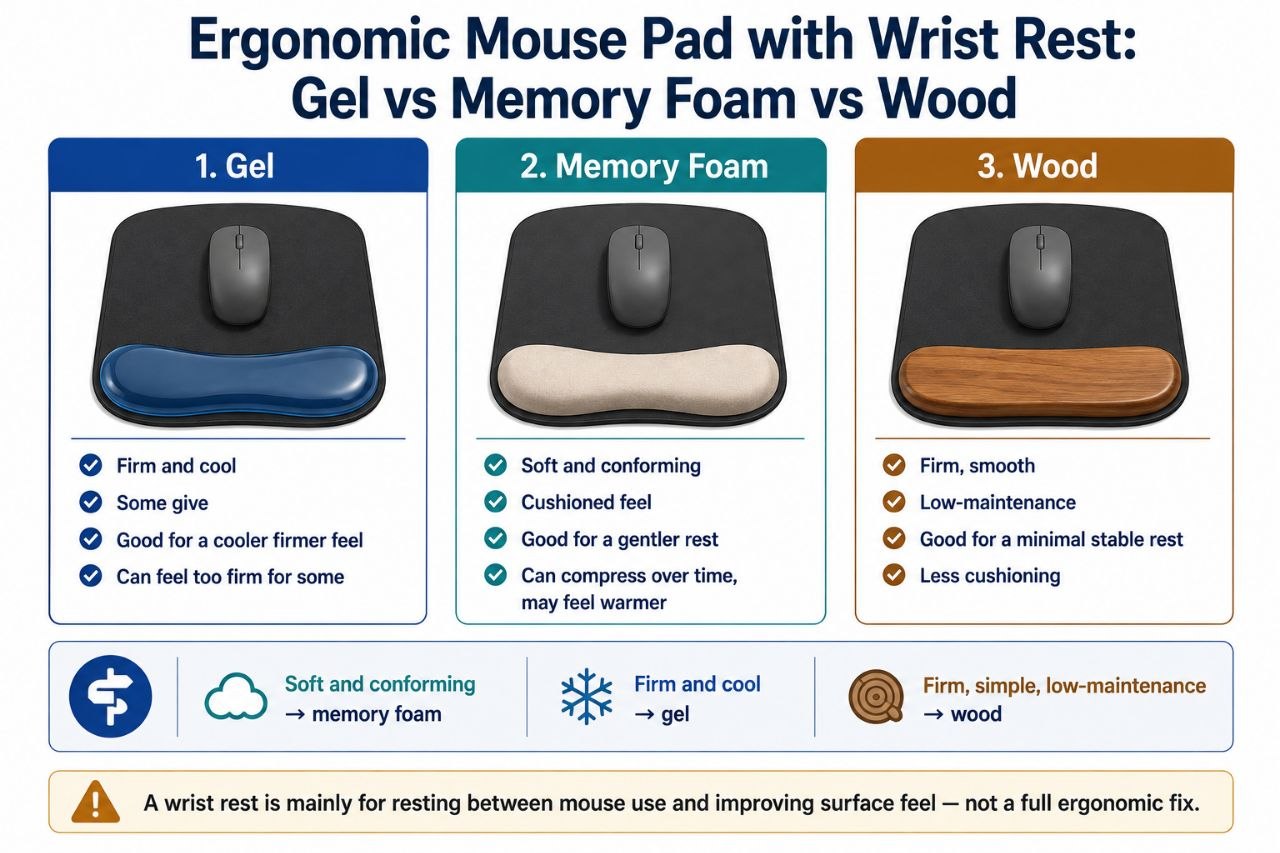
The feel: Gel tends to be cool, slightly firm but with some give. It can feel supportive without being as soft as foam.
Where it tends to fit:
- People who like a firmer, cooler resting surface.
- Someone who wants a wrist rest that does not compress as much as foam.
- A setup where a cooler feel is preferable.
Watch out for:
- Gel can feel unusual or too firm for some people.
- The surface feel matters — if it is too slick or too hard against your skin, it may not be comfortable for long sessions.
- A gel rest is still a wrist rest; it does not fix a bad mouse position or arm posture.
Memory foam wrist rest
The feel: soft, conforming, and cushiony. Memory foam compresses a bit under pressure and adapts to the shape more than a firm surface.
Where it tends to fit:
- People who want a softer, more cushioned rest.
- Someone who likes a surface that feels gentle under the wrist.
- A setup where a plusher feel is the goal.
Watch out for:
- Foam can compress over time and change the feel.
- Too soft or too thick can encourage an awkward wrist angle rather than a neutral rest.
- Some people find foam runs warmer than other materials.
Wood wrist rest
The feel: firm, smooth, and stable. Wood is the least cushioning of the three but can feel clean and solid.
Where it tends to fit:
- People who prefer a firm, minimal rest.
- Someone who likes a smooth, cool, simple surface.
- A setup where a low-profile, low-maintenance rest is appealing.
Watch out for:
- Less cushioning means less softness — if you want a cushioned feel, wood will not give it.
- The surface should be smooth enough to rest on comfortably.
- Better for light resting than for long, heavy contact for some people.
How to choose
A simple way to think about it:
- If you want soft and conforming: memory foam.
- If you want firm and cool: gel.
- If you want firm, simple, and low-maintenance: wood.
The material you pick should match the feel you actually want, not just the first image you saw. A wrist rest that feels off to you will not help much just because it is “ergonomic” in name.
A practical caution
A mouse pad with a wrist rest is a small comfort and positioning aid, not a full ergonomic fix. It can improve the feel under your wrist during mouse use, but it does not replace good mouse position, good arm posture, or a setup that keeps your wrist in a reasonably neutral position.
Also, a wrist rest is mainly for resting between active mouse use, not for forcing your wrist into a fixed position while you work. If it pushes your wrist into an awkward angle, it is not doing its job.
When any of them makes sense
- Your wrist rests on the desk or mouse pad during mouse use and you want a more comfortable surface.
- You want a defined, slightly better-feeling rest area for your wrist.
- You are choosing based on feel and material preference rather than expecting a big ergonomic change.
When it is marginal
- Your mouse position and arm posture are already fine and the surface feel is not a real issue.
- You expect the wrist rest to solve a bigger problem than it can.
- The material feel you pick is one you would not enjoy in daily use.
Bottom line
Gel, memory foam, and wood mouse pads with wrist rests each give a different feel: firm and cool, soft and conforming, or firm and minimal. Pick the material that matches the kind of rest you want and the feel you are comfortable with. The material matters because it changes the daily feel, but the rest is still a small aid, not a complete ergonomic solution.