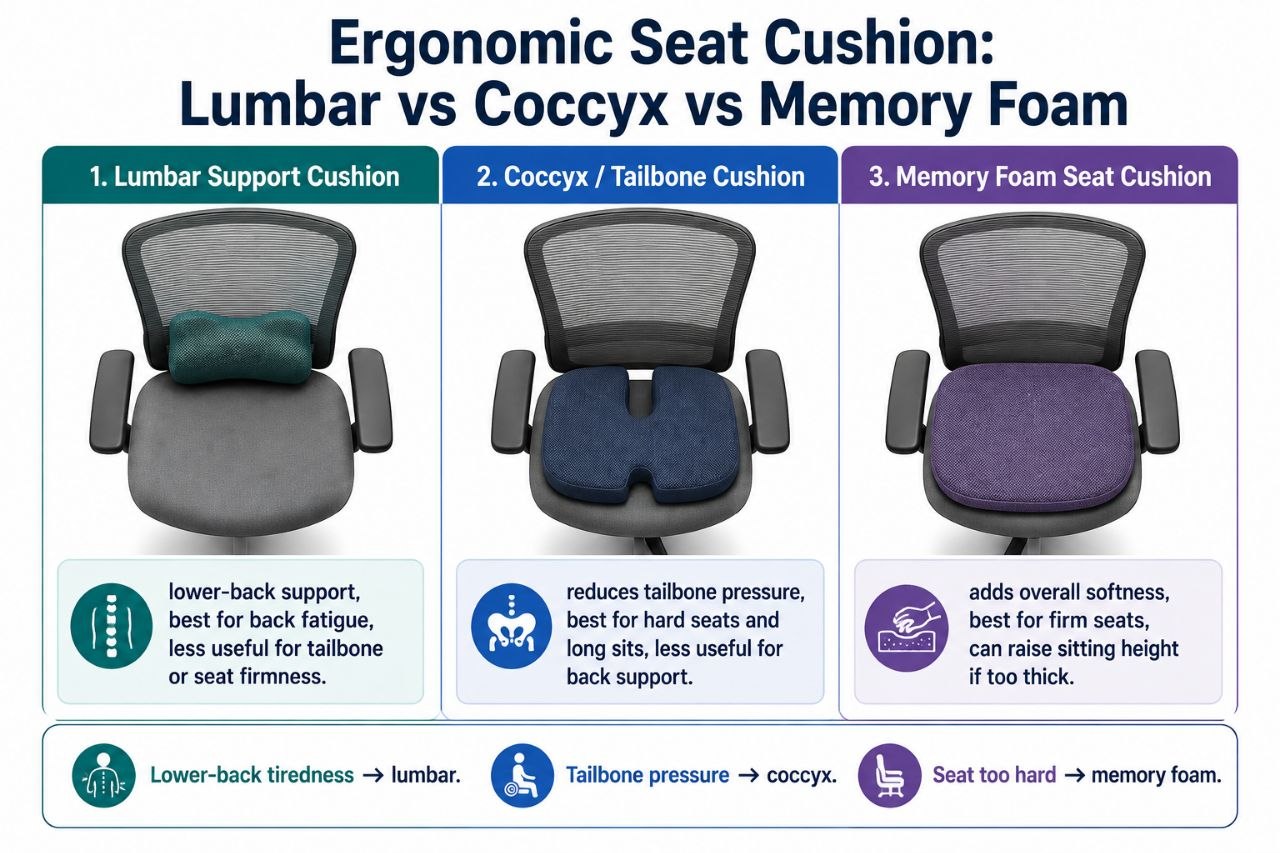
The first question: what discomfort are we addressing?
Seat cushions are not a single thing. The right one depends on where your discomfort actually comes from. A cushion that helps lower-back fatigue may do little for tailbone pressure. A tailbone cushion may not help much if your problem is overall seat firmness.
The three common types are:
- Lumbar support cushions — placed against the lower back, aimed at supporting the curve of the spine.
- Coccyx / tailbone cushions — designed to take pressure off the tailbone, often with a cutout or wedge shape.
- Memory foam seat cushions — a broader cushion that adds overall softness to the seat surface.
The mistake is buying one and expecting it to fix everything.
Lumbar support cushions
What they are for: lower-back support. If your chair back feels too flat or you find yourself slumping to get comfort, a lumbar cushion can help fill the gap.
Good fit for:
- People who feel lower-back fatigue during long sitting.
- Chairs with limited built-in lumbar support.
- Someone who wants a reminder to keep a more supported posture.
Less useful for:
- Tailbone pain.
- Seat firmness complaints.
- Problems caused by chair height or desk position rather than back support.
Coccyx / tailbone cushions
What they are for: reducing pressure on the tailbone area. These are often the cushions people reach for when the hard edge of a seat is the main annoyance.
Good fit for:
- People who feel pressure or soreness in the tailbone area during long sits.
- Hard-seat situations — firm office chairs, dining-style chairs, or seats without much padding.
- People who sit for long continuous stretches.
Less useful for:
- Lower-back fatigue that is not tailbone-related.
- Situations where the main problem is overall seat height or posture.
- People who mostly stand or move around a lot.
Memory foam seat cushions
What they are for: overall softness. A memory foam cushion spreads pressure over a wider area of the seat, making a firm seat feel more forgiving.
Good fit for:
- People who find their seat too hard overall.
- Chairs with minimal padding.
- Someone who wants a general comfort upgrade rather than a targeted support solution.
Less useful for:
- Targeted tailbone pressure, where a coccyx cushion may be a better fit.
- Lower-back support, where a lumbar cushion is more specific.
- Situations where the cushion makes you sit too high relative to the desk — that can create a new problem.
How to choose
A simple way to think about it:
- If your main complaint is lower-back tiredness: lumbar support cushion.
- If your main complaint is tailbone pressure: coccyx cushion.
- If your main complaint is the seat itself feels too hard: memory foam seat cushion.
If you are not sure, think about where you feel the discomfort first during a long sitting session. That is a decent hint about which type is worth trying first.
A practical caution
A seat cushion changes your height relative to the desk. If it lifts you enough, your feet may no longer rest comfortably, or your keyboard may end up at a less ideal height. A good cushion should improve comfort without creating a new fit problem.
Hemi Life connection
Hemi Life carries an office ergonomic chair cushion that fits the broader category of seat comfort support. If you already use an ergonomic chair — for example, one you evaluated in an article like “Ergonomic Chair vs Regular Chair: What to Check Before You Buy” — the cushion is an add-on to that setup rather than a replacement for a good chair.
Bottom line
The right seat cushion depends on the specific discomfort you are solving. Lumbar cushions target lower-back support, coccyx cushions target tailbone pressure, and memory foam cushions add overall softness. Pick the type that matches your main problem, and check that it does not throw off your chair-and-desk fit.