Do you actually need an under-desk footrest? Honest answer: not everyone does. If your feet already rest flat on the floor with your knees near hip height and you feel comfortable throughout the day, a footrest probably will not change anything for you. But if your feet dangle, your chair is a little too high, or you shift restlessly after a few hours, a footrest is one of the simplest and cheapest ergonomic upgrades you can make — and this guide will help you decide whether to spend or skip.
The Honest Case for Owning One
A footrest does not correct your posture on its own. What it does is give your feet a stable, comfortable surface so you can keep your hips and knees in a more neutral position. When your feet are planted properly, your body tends to sit in a more balanced way, which can reduce the urge to slouch or slide forward.
You are more likely to benefit from a footrest if any of these sound familiar:
- Your feet do not reach the floor comfortably when you sit back in your chair.
- You find your feet dangling, or you tuck them under your chair out of habit.
- Your desk is tall enough that your knees sit below hip level.
- You tend to cross your legs, rock, or shift restlessly for most of the day.
- You spend long, continuous hours at your desk and want to vary your leg position.
For most people the real benefit is comfort. Sitting with your feet unsupported, especially if you are shorter or your chair seat is a little high, can leave your lower back and thighs feeling tired by the end of the day. A footrest can help you keep a more relaxed leg position when your feet do not reach the floor, and it lets you change your leg position now and then — which is generally good for staying comfortable during long sessions.
The Honest Case Against — When It Is Probably a Waste
A footrest does not add value to every desk setup. Here is when you can safely skip it:
- Your feet rest fully flat on the floor and your knees sit at roughly 90 degrees.
- You already feel comfortable and do not find yourself shifting or fidgeting for support.
- Your chair height and desk height already match your body well without extra help.
- You are happy with your current arrangement and do not think about your feet at all — that is a good sign.
If you check all of these, buying a footrest is unlikely to improve your comfort. The goal is simply to find a position where your feet are supported and your legs are comfortable — and if you already have that, there is nothing to fix.
Cheaper or Free Alternatives to Try First
Before spending money, it is worth trying something you probably already have at home. A footrest does not need to be a purpose-built product to help you figure out whether the idea works for you.
- A sturdy box or a stack of books. Place it under your desk and rest your feet on it. If it brings your knees closer to hip height and you feel more comfortable, a real footrest may be worth buying.
- An angled stack. Tilt a book or a small board against a box to create a slight incline. This simulates the angled surface many footrests provide and lets you test whether a tilt helps.
- A rolled towel. Place a firmly rolled towel under your desk and rest the arches of your feet on it. It is not a long-term solution, but it gives you a quick sense of whether elevation helps.
These experiments cost nothing and take five minutes. If they make a noticeable difference, a proper footrest is likely worth it. If they do nothing for you, you have just saved yourself the purchase.
If You Do Need One: Fixed-Angle vs Adjustable Height
Footrests come in two broad types, and the difference matters for how well one will suit you.
Fixed-Angle Footrests
These are the simplest and often the cheapest options. A fixed footrest is angled in one position and expects your feet to rest at that angle. If that angle suits your height and chair, they work well and stay out of the way. They typically suit people who use the same chair at the same desk every day and already know roughly what height and tilt they need.
The trade-off is that you cannot change the position if it does not match your setup. If you share the desk, switch between sitting positions, or find the ideal angle changes through the day, a fixed model may not give you enough flexibility.
Adjustable Footrests
Adjustable models let you change the height and usually the tilt, so you can dial in a position that matches your chair and desk. They cost a little more, but they are more forgiving if you share the desk, switch between sitting positions, or find the ideal angle changes through the day.
Within the adjustable category you will often see two features worth understanding: a range of height settings and a tilting top that you can raise or lower. These let you match the footrest to your own legs rather than adjusting to a fixed design. If you are unsure which angle will work, an adjustable model is the safer bet.
Tiered Buying: What Each Price Level Realistically Buys
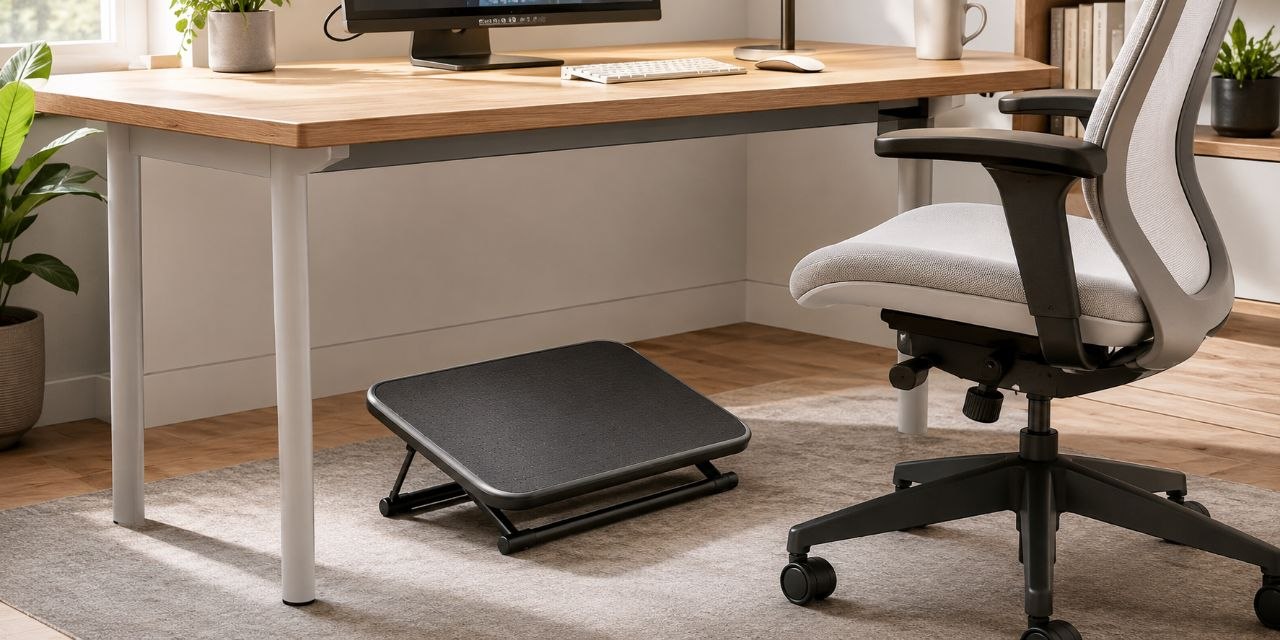
Footrest prices span a wide range, and what you get at each level is fairly predictable. Here is what to expect at each tier.
Budget Tier (Typically Around $20–35)
At this level you get a fixed-angle foam or basic plastic footrest. It usually has a textured top surface for grip and a single fixed tilt. Height adjustment is minimal or absent. These work fine if you already know the angle you need and your chair height does not change. Do not expect adjustability or premium materials — you are paying for a stable angled platform and not much else.
Mid-Range Tier (Typically Around $35–55)
This is where adjustable footrests start to appear. A typical mid-range model is built from high-impact plastic, gives you a few height settings plus a top that tilts, and includes a textured or ridged surface so your feet do not slip. The compact footprint makes it easy to slide under most desks and store away. This tier covers most home-office needs: you get enough adjustability to match different chair heights and sitting positions without spending a lot.
Premium Tier (Typically $60 and Above)
Premium footrests tend to offer a wider platform, finer height and angle adjustments, and sometimes a rocker-style base that lets you tilt your feet back and forth — which some people find helpful for staying active while seated. Build quality steps up: thicker materials, more robust adjustment mechanisms, and surfaces designed to hold up under daily use. These are worth considering if you spend long hours at your desk every day and want the most flexibility, or if a cheaper model has not felt quite right.
Most people will find the mid-range tier hits the sweet spot — enough adjustability to get comfortable, without paying for features they may not use.
What to Look for When Choosing
Once you have narrowed down the type and tier, a few details help separate a footrest that works from one that sits unused.
Height Range
Look for a footrest that can adjust to a height you actually need, not just one that looks adjustable. A typical compact footrest offers several height settings, and the total range matters more than any single number. The range should be enough to bring your knees near hip level when your feet are resting on it.
Angle Adjustment
Being able to tilt the top surface is useful because a completely flat footrest rarely matches how most people sit. A slight tilt can encourage a more natural foot position, and many find it more comfortable. If you can adjust the angle, you can find the setting that works rather than accepting whatever the fixed design gives you.
Traction and Grip
A textured top surface keeps your feet from slipping, which is more important than it sounds. A smooth plastic surface can let your feet slide, which then makes you shift and lose the stable position you added the footrest for. A grippy or textured surface keeps your feet planted.
Size and Fit
Make sure the footrest fits comfortably under your desk and does not force you to sit further back than you would like. A very wide model can be awkward in a small setup, while a very narrow one may not give both feet a comfortable resting surface.
Build Quality
Because a footrest takes your weight and is kicked around under a desk, a sturdy design matters. High-impact plastic is common and works well for a compact model. Check that the adjustment mechanism feels solid rather than flimsy, and that the footrest does not shift when you rest your feet on it.
How to Set It Up Correctly
Once you have a footrest, a little setup goes a long way.
- Place it so your feet rest on it with your knees roughly at hip height or slightly below.
- Adjust the tilt so your heels rest slightly ahead of your toes, in a natural position.
- Try a few height and angle settings, and pick the one that feels most stable for more than a few minutes.
- Change your leg position occasionally. A footrest supports change, not a locked-in pose.
The aim is a comfortable, planted position you can hold without fidgeting. If the footrest does not let you reach that after trying a few settings, it may not match your body — try the height and angle adjustments before you settle on the purchase.
How a Footrest Fits Into Your Overall Setup
A footrest is one piece of a larger ergonomic picture. It works alongside a chair and desk that suit your height, and it is not a replacement for getting up and moving during the day. If you are still adjusting the rest of your workspace, it can help to settle your chair and monitor first, then add a footrest for the final level of comfort.
For a fuller view of the wider setup, our guide to a complete ergonomic home office setup covers the chair, desk, and screen together. If your chair height is the reason your feet do not reach the floor, our guidance on an ergonomic chair vs a regular chair is also worth a look before you spend on a footrest.
How We Kept the Footrest Question Honest
Footrests are easy to over-sell because they are small and cheap and everyone has a foot that touches the floor sometimes. We deliberately started from the necessity question: do you actually need one? That framing keeps the article from drifting into “buy this because it is ergonomic” territory. Where the evidence is thin — for example, how much a footrest improves posture for someone who is not already uncomfortable — we say so instead of papering over it.If the issue is more about your chair than your feet, see our ergonomic chair vs regular chair guide for the bigger seating decision.