Last updated: September 2026 · Written by Hemi
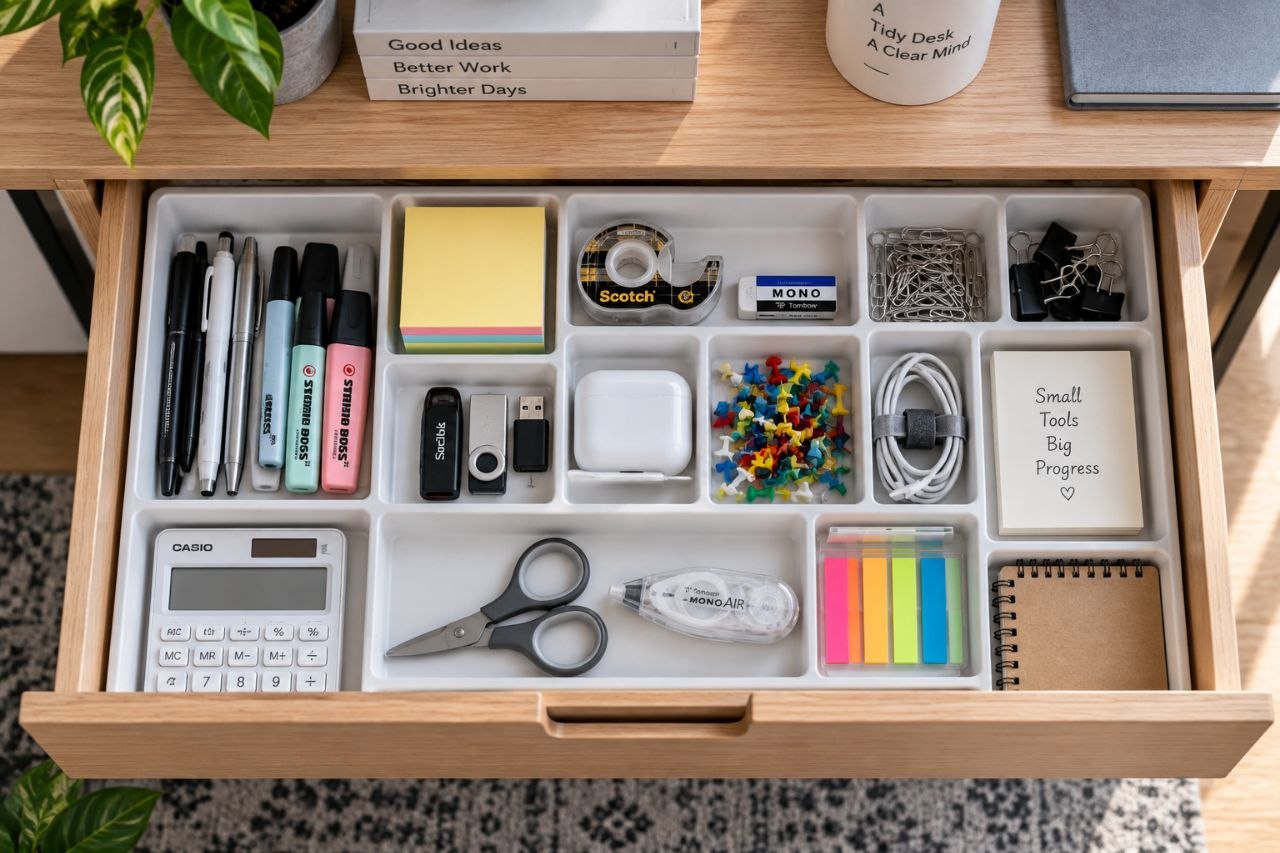
A desk drawer organizer is how you keep the desktop clean without pretending you own nothing. The desktop holds daily tools; the drawer holds the rest — cables, adapters, stationery, and the random hardware that otherwise migrates onto the keyboard zone. Without a drawer system, even a good desktop tray eventually overflows.
What Belongs in a Drawer vs on the Desk
- On desk: items used multiple times per workday.
- In drawer: weekly items, spare cables, backup earbuds, markers, batteries.
- Elsewhere: archives and rarely used adapters — not in the prime drawer.
Organizer Styles That Actually Help
- Adjustable grids — expanders that fit the drawer footprint; good default.
- Fixed trays — tidy but only if compartment sizes match your objects.
- Deep bins — useful for bulky bricks; bad for tiny items that vanish at the bottom.
A Simple Sorting Method
- Empty the drawer completely onto the desk once.
- Trash or recycle dead cables and dried pens.
- Group by use: write, power, audio, misc.
- Assign one compartment per group; leave one empty inbox slot for new clutter.
- Put back only what survived the sort.
Pairing With Desktop Systems
Drawer organization works best beside an on-desk organizer and under-desk cable tray. The desktop stays sparse because the drawer absorbs overflow. If cables are still the main chaos, fix routing first — a neat drawer will not help a tangled floor nest.
Failure Modes
- Filling every compartment until nothing is findable.
- Storing heavy power bricks in a drawer that then cannot open fully because of cable tension.
- Using the drawer as long-term archive — that is a storage-box problem, not a desk problem.
Shop the Hemi Life pick
Expandable Bamboo Drawer Organizer — Check on Hemi Life.
Dual Monitor Stand Riser With Drawers — Check on Hemi Life.
Bottom Line
Treat the drawer as overflow with rules, not as a hidden junk room. Adjustable grids plus a one-time sort usually beat buying a larger desktop organizer.
Label one compartment as temporary inbox and empty it weekly. That single habit prevents the drawer from becoming a second junk desktop.
If your desk has no drawer, a shallow under-desk slide drawer or a nearby rolling caddy can play the same role. The principle is overflow with boundaries — not a specific furniture SKU.
Do a five-minute Friday reset: return stray items to compartments, empty the inbox slot, and remove anything that has sat untouched for a month. Organization systems fail from skipped maintenance more often than from wrong trays.
Keep liquids out of drawers that hold electronics accessories. A leaked bottle in a closed drawer is a quiet disaster for dongles and spare buds.
Store spare cables coiled with a label on the end (device name, not just “USB”). Future you will not remember which unmarked black cable belongs to which brick.
If drawers stick, reduce fill volume before lubricating slides. Overstuffed organizers create mechanical problems that look like furniture defects.
Pair drawer resets with desktop resets. A clean drawer beside a chaotic desktop just relocates the same habit.