Last updated: September 2026 · Written by Hemi
Monitor light bars and desk lamps are often sold as interchangeable “eye strain” fixes. They are not. One mainly lights the desk zone under and behind the screen without washing the display. The other lights a wider desk area and depends heavily on where you put it. The useful question is which mismatch you are actually trying to fix.
What a Monitor Light Bar Is Good At
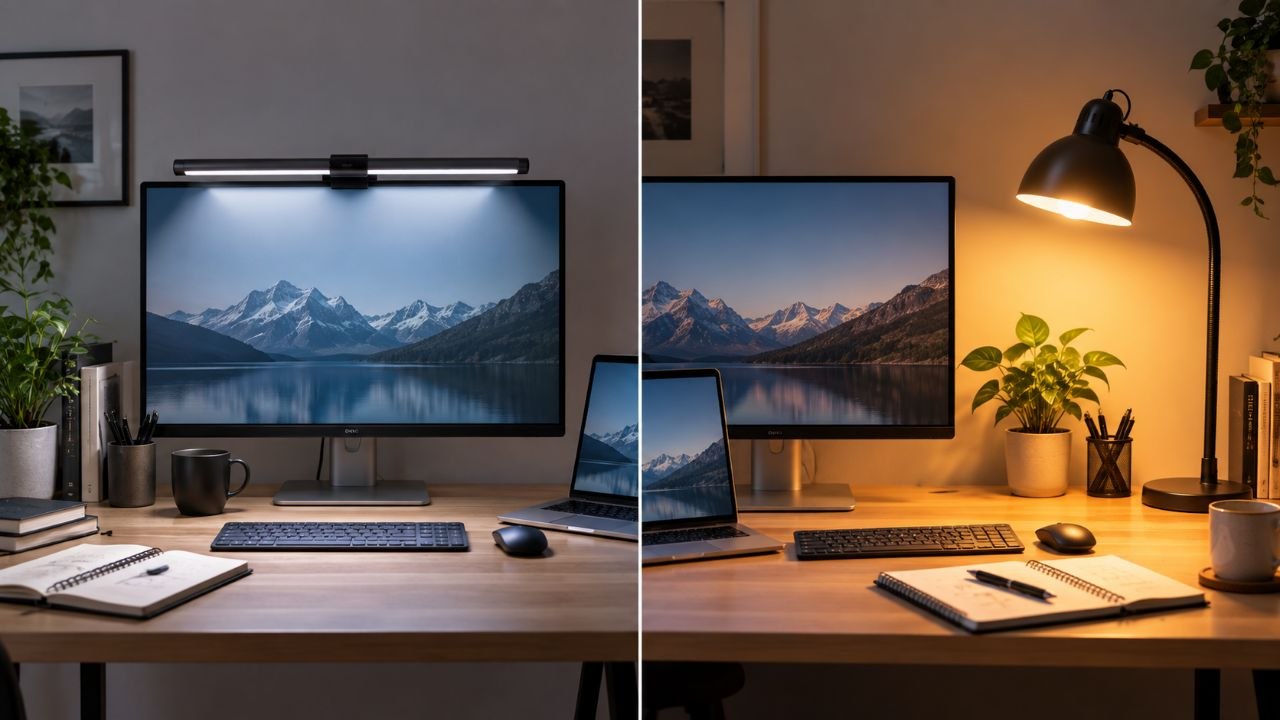
A monitor light bar clips or sits on the top edge of the display and casts light downward onto the desk. Because the light comes from above and behind the screen plane, it can illuminate keyboard and notes with less direct reflection on the panel than a poorly aimed side lamp.
- Lower screen wash when the bar is aimed correctly.
- No base footprint — useful on narrow desks.
- Focused task zone around the keyboard and immediate desk surface.
Limits: coverage is usually narrower than a desk lamp. Document-heavy work spread across the desk may still feel dim at the edges. Some bars have limited colour-temperature range. Mounting quality varies — a loose clip becomes annoying fast.
What a Desk Lamp Is Good At
A desk lamp covers a wider area and can light notebooks, reference pages, or a secondary work zone that a bar never reaches. Many lamps offer broader brightness and colour-temperature control.
- Broader coverage for paper work and mixed tasks.
- Flexible aiming if the arm and head move freely.
- Easier ambient layering with room lighting.
Limits: placement mistakes create glare. The base uses desk space. A bright lamp beside a dark room can still produce the harsh contrast that tires your eyes.
Side-by-Side Decision Table
Use this as a situation map — not a ranking:
- Main problem is glare on the screen → start by testing a well-aimed light bar (and check screen brightness/angle).
- Main problem is a dim whole desk / paper work → a desk lamp with adjustable warmth is usually the better first tool.
- Narrow desk, no room for a base → light bar has a practical advantage.
- You already have decent ambient light and only need keyboard-zone fill → either can work; prefer the one that does not fight the screen.
Can You Use Both?
Yes. Many setups work well with a light bar for the screen-adjacent zone and a small lamp for a side notebook area. That is not “more products for the sake of it” — it is matching tools to zones. If one tool already removes the discomfort, stop there.
What Neither Product Fixes
Neither product fixes an overly bright screen in a dark room by itself, a monitor mounted far too low, or long sessions without breaks. Lighting is one layer of comfort, not a complete ergonomic system.
How We Compare These Options
This is a category and use-case comparison based on how each form factor behaves. We do not claim lab testing of every light bar or lamp on the market. Judge any specific product by its published aiming range, dimming behaviour, mount type, and whether it fits your desk depth.
Shop the Hemi Life pick
LED Monitor Light Bar — USB Dimmable Screen Lamp — Check on Hemi Life.
LED Desk Lamp — Check on Hemi Life.
Bottom Line
If glare is the primary complaint, a monitor light bar is often the more direct experiment. If the whole desk is under-lit or you work on paper, choose a desk lamp you can aim and dim. Combine only when each tool has a clear zone to cover.